
Bone health known before the operating room.
For practice leaders, arthroplasty surgeons, orthopedic and neurosurgical spine surgeons, and bone health teams. Low bone density is linked to screw and implant loosening and to fractures around implants, yet many patients arrive for surgery without a diagnosis.1,2,3 Rho flags patients who may have low bone density in the frontal knee, pelvis and spine X-rays you take, so bone health can be optimized before, during and after surgery.
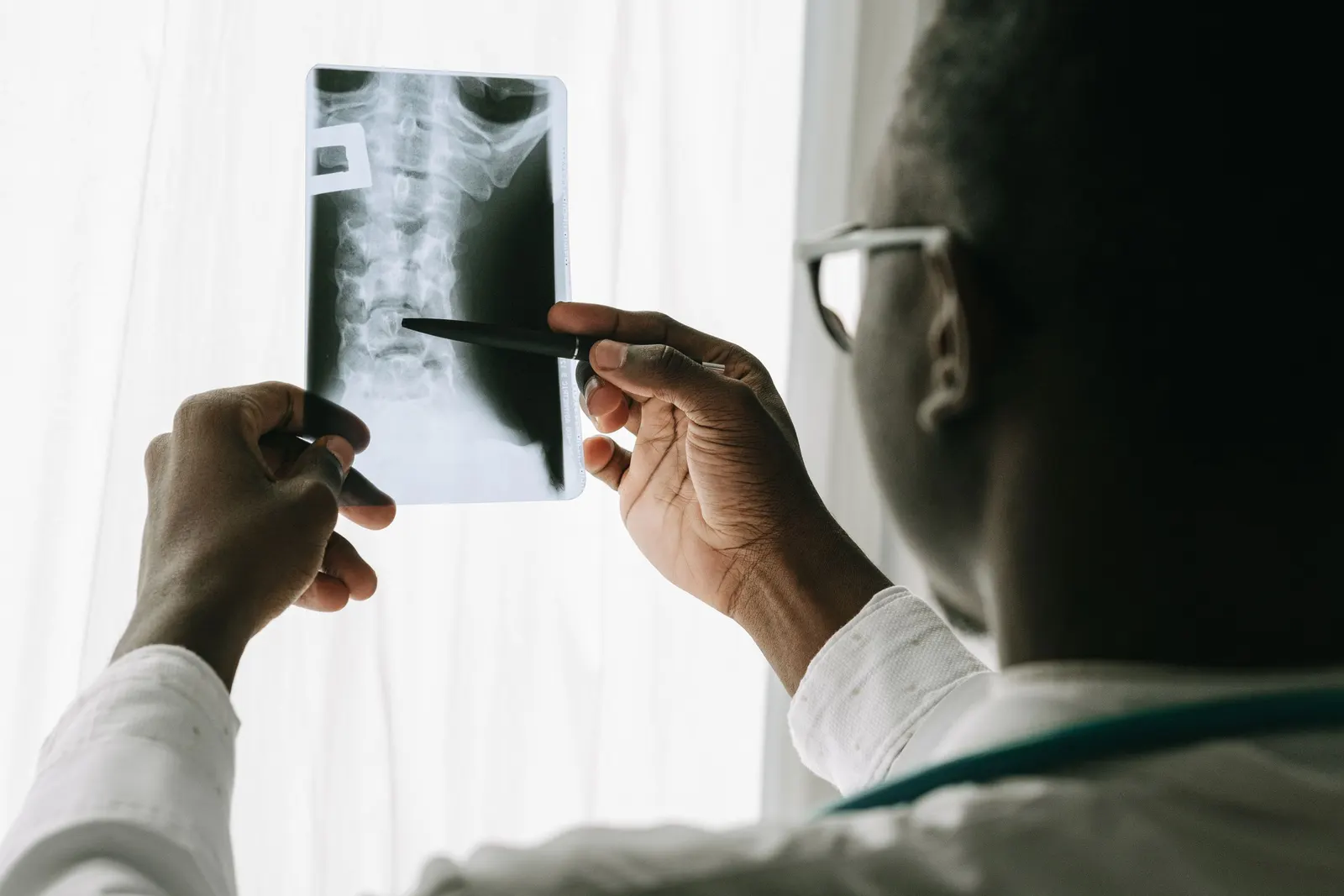
Half of joint replacement patients should be screened. Few are.1
- 12 to 13%
Of hip and knee arthroplasty patients who met osteoporosis screening criteria had a preoperative DXA, in a claims study of more than 1.1 million patients. 53 to 55% met the criteria.1
- 1 in 4
Elective joint replacement patients met criteria for osteoporosis treatment. About 5% received it before or after surgery.4
- 2 in 3
Lumbar fusion patients had impaired bone quality on preoperative CT (31% osteoporosis, 34% osteopenia). 37% of those with osteoporosis were undiagnosed.2
Instrumentation depends on the bone it sits in.
Spine surgeons have known this longest: fusion, screw purchase and the junction above a construct all depend on bone quality. The arthroplasty literature now shows the same pattern for periprosthetic fracture and revision.1,3
Spine
- 3.3×
Odds of revision after single-level lumbar fusion in patients with osteoporosis, and 1.9× the odds of pseudarthrosis, in 5,169 propensity-matched patients.5
- 63% vs 12%
Proximal junctional kyphosis or failure when bone at the upper instrumented vertebra measured under 110 Hounsfield units, compared with over 160.6
- 1 in 4
Adult deformity patients who developed proximal junctional kyphosis across 18 studies. Those who did had T-scores 0.69 lower on average.7
Hip and knee
- 1.6 to 1.7×
Periprosthetic fracture within five years in high-risk hip and knee arthroplasty patients compared with low-risk patients, and 1.8 to 2.1× fragility fracture.1
- 1.8×
Five-year revision for periprosthetic fracture after knee arthroplasty in patients with a coded osteoporosis diagnosis, in 418,054 primary TKAs.8
- 73%
Of osteoporotic patients aged 70 and older having a hip replacement had not been diagnosed before surgery.3
- 1 Agarwal, Malyavko, Gu et al., CORR, 2023 ↗
- 3 Delsmann et al., Osteoporosis International, 2021 ↗
- 5 Khalid et al., Neurosurgical Focus, 2020 ↗
- 6 Mikula et al., Operative Neurosurgery, 2021 ↗
- 7 Chen et al., Journal of Neurosurgery: Spine, 2023 ↗
- 8 Harris et al., Journal of Arthroplasty, 2024 ↗
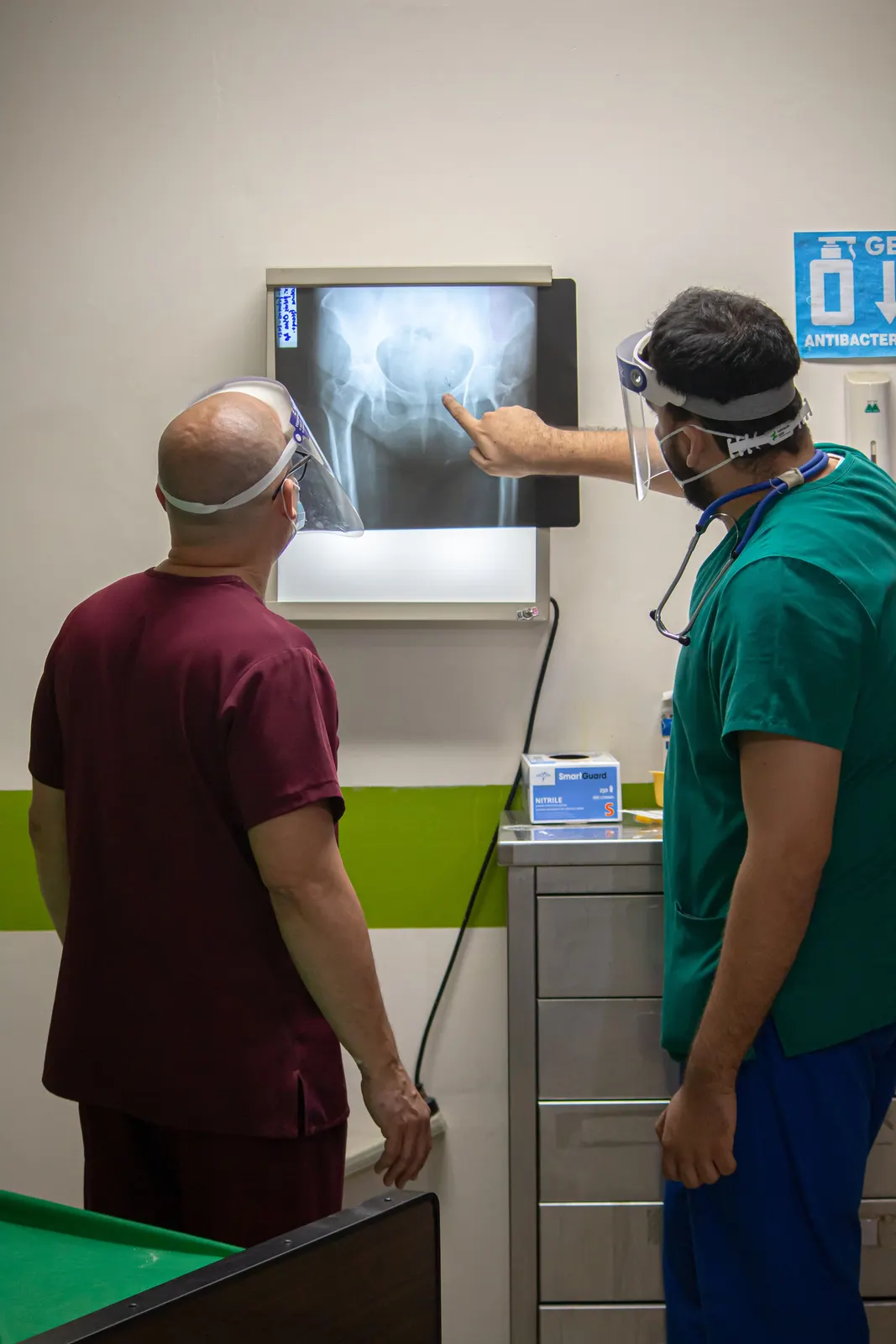
Optimized bone changes outcomes.
Spine surgery best-practice guidelines call for starting anabolic therapy before instrumenting osteoporotic bone, yet most eligible patients still reach surgery untreated.9,10,11 The evidence behind that recommendation, and the guidance that formalizes it, is summarized here with its caveats.
“As an orthopedic spine surgeon, I consider the bone health of almost every patient who comes into my clinic.
Rho leverages x-rays that we already routinely obtain to provide an initial layer of screening for jeopardized bone quality that requires no extra radiation or testing. The integration with PACS allows for practical integration into a busy orthopedic practice.”
 James Bernatz, MD Orthopedic spine surgeon, UW Health
Guidelines now expect it
The Congress of Neurological Surgeons gives a Grade B recommendation that preoperative teriparatide increases bone density and produces earlier, more robust fusion. An 18-expert consensus calls for a formal bone health evaluation in every patient over 65 before elective spinal reconstruction, with anabolic therapy first line and at least two months of treatment before surgery.12,9
Treated bone fuses and holds
In 540 long-fusion patients, those with osteoporosis treated with teriparatide had a reoperation rate of 11.5% versus 23.1%, and pseudarthrosis of 6.4% versus 21.8%, compared with untreated osteopenic patients, and did no worse than patients with normal bone. A Level I trial found significantly higher CT fusion at four and six months with teriparatide, and a meta-analysis put the odds of fusion at 2.2× with it.13,14,15
Implants last longer
In 41,995 hip and knee replacements, patients on bisphosphonates had a five-year revision rate of 0.93% versus 1.96%, with implant survival roughly doubled. The evidence is observational and the periprosthetic fracture picture is mixed, so the gain to claim is in revision and loosening.16
A pathway changes behavior
When one spine program added a bone health optimization clinic, 89% of referred patients had their bone density measured, against 10% of those not referred, and every referred patient who met treatment criteria was treated before surgery, against 25%. The AOA recommends assessing every patient aged 50 and older and, where treatment is indicated, delaying elective surgery by at least three months to begin it.17,10
- 9 Sardar et al., Spine, 2022 ↗
- 10 Anderson, Jeray, Lane, Binkley, JBJS, 2019 ↗
- 11 Jain et al., Global Spine Journal, 2022 ↗
- 12 Dimar et al., Neurosurgery, 2021 ↗
- 13 Mohanty et al., JBJS, 2024 ↗
- 14 Ebata et al., JBJS, 2017 ↗
- 15 Fatima et al., Neurosurgical Review, 2021 ↗
- 16 Prieto-Alhambra et al., BMJ, 2011 ↗
- 17 Bernatz et al., JAAOS Global Research and Reviews, 2022 ↗
Industry note: several of these studies have authors who consult for or were supported by manufacturers of anabolic agents, and the arthroplasty evidence is observational. We cite them because they are the current literature, not as claims about Rho. Rho flags patients for assessment; it does not diagnose osteoporosis or recommend treatment.
One month of imaging at Campbell Clinic Orthopaedics.
16 Bit ran Rho retrospectively on one month of imaging from Campbell Clinic Orthopaedics, a US orthopedic practice with 12 locations. No new scans, no workflow change. The question was simple: how many patients already in the building show signs of low bone density?
- 5,940
Patients aged 50 and older with at least one imaging study that month.
- 2,146
Had a view Rho can read: knee, pelvis, hand or wrist, or lumbar spine, with a few thoracic spine and chest films.
- 772
Patients flagged Rho Positive in one month, 36% of those screened.
- 1,128
Patients flagged Rho Positive in one month, 53% of those screened.
Men are rarely screened for osteoporosis, and nearly a third of the men imaged were flagged.
Retrospective analysis by 16 Bit, 2026, of imaging from April 2024. Patient-level counts. Data on file; not peer reviewed. Flag rates are not a diagnosis of osteoporosis and were not confirmed by DXA in this analysis.
“We weren’t missing the patients. We were missing the disease.
That was the eye-opening realization when we retrospectively analyzed imaging from patients already coming through our orthopedic clinics. Low bone density was hiding in plain sight, often in patients we were actively treating for entirely different conditions.
Rho has fundamentally changed how we identify these patients. Integration into our existing IT infrastructure was remarkably straightforward, thanks to an exceptionally responsive and collaborative team. Now, instead of relying on individual providers to recognize and initiate osteoporosis screening, we have a systematic approach to identifying at-risk patients across our practice.
For orthopedic and spine surgeons, this represents an enormous opportunity to identify compromised bone health earlier and optimize patients before surgery. Rho has transformed our ability to find the patients who need us most, often before they even know they have a problem.”
 Christopher T. Cosgrove, MD Director, Center for Bone Health, Campbell Clinic Orthopaedics
From a flag in PACS to a patient in your bone health clinic.
Each step is a service that practices can offer, and each is better for the patient than discovering poor bone at revision. Medicare Part B covers the visit, a bone mass measurement every 24 months (more often if medically necessary) and injectable osteoporosis drugs for eligible patients, and coverage by other payers varies.19Public and private payers in many countries cover the visit, bone density testing and osteoporosis treatment for eligible patients; coverage varies by country and payer. Rho supplies the first step at scale.
- 18 ISCD official position on bone health evaluation in orthopedic surgery (Anderson et al., Journal of Clinical Densitometry, 2019) ↗
- 19 Medicare.gov, Bone mass measurements ↗
Built for the films you take every day.
Knee, pelvis, hand or wrist, and lumbar spine
Rho reads frontal views of the knee, pelvis, hand or wrist, lumbar spine, thoracic spine, and chest in patients aged 50 and older. Preoperative and clinic films count. Rho's performance has not been established on X-rays with fracture, hardware, osteophytes or tumors.
A report where your surgeons look
Rho sends a Rho Positive report to PACS as an image series in the same study. By default, negative studies get no report in PACS, and the absence of a report does not rule out low bone density. The Rho Report arrives in PACS as an image series in the same study, with a Rho Score from 1 to 10 and the frequency of low bone density at that score in the validation study.
Installed in your network in about an hour
Rho Enterprise runs on one virtual machine within your network with standard DICOM routing from PACS. Installation, IT training and configuration usually take about an hour, and Rho is designed so that images stay in your environment.
No PACS integration yet? Start with Rho Direct
Upload DICOM studies from a browser and get a Rho Report back, usually within seconds, with patient identifiers encrypted on your device. Useful for a pilot or a single surgeon's preoperative clinic.
About Rho Direct →In clinical and research use at imaging networks, orthopedic groups, and hospitals around the world



See what Rho would flag in your practice.
Ask about a retrospective analysis of one month of your imaging: how many patients Rho would flag, by age, sex and body part, and how many had a DXA on file. The analysis runs on your site; images stay in your environment.